Character development
How do choices, motives and relationships change a person during a story?
Ask: “What changed in the character, and what proves it?” Try Character Encounter ↗
A comic panel, manga chapter, animated film or television scene can offer a pathway into rich literary thinking. The teaching work is to make its language and concepts explicit.
Choose a literary lens, then ask learners to find evidence in the visual story and apply the same thinking to a written passage. Filter the ideas by teaching focus.
How do choices, motives and relationships change a person during a story?
What problem drives the story—and what causes events to follow one another?
Small early details prepare readers for a later surprise, danger or revelation.
Locate turning points, consequences, closure and unfinished narrative threads.
Compare experiences to create fresh meaning, literally or figuratively.
Sound-based words such as crash, buzz and whoosh turn hearing into language.
Spoken language reveals personality, power, conflict and background.
Sensory words and descriptive patterns create an emotional atmosphere.
Recurring objects or colours can carry meaning beyond what they literally show.
The story changes depending on what a narrator sees, knows and omits.
Interpretation should be justified by visible or written details.
Identify a story’s concerns and ask how culture or identity shapes representation.
The struggle that drives a story.
The choices that reveal character.
Conflict is more than a fight or an argument. In literature it is the tension between competing wants, values, needs or circumstances. It propels events, exposes motivation, creates turning points and makes character development visible. Beyond the page, examining conflict can create a safe starting point for teaching perspective-taking, self-control, communication, responsibility and respectful disagreement.
Conflict gives a character something meaningful to confront. Watch how the struggle changes the plot and tests the character's values.
Story characters offer learners a little distance from real disputes. Guided discussion can help them rehearse more constructive responses in their own lives.
Stories do not merely show what happens to a character. They ask what the character chooses to do next—and whether that choice changes them.
Identify the struggle. Who wants what, and why?
Read words and visual clues for feelings and motives.
Consider possible responses and their consequences.
Describe what the character learns—or fails to learn.
“You never let anyone else lead!”
“I just want our project to be good.”
Both students want to lead the class presentation. Amara feels ignored. Kai worries the group will fail. Their argument grows louder, while a third group member stops speaking.
Literary lens: person versus person, with fear and pride beneath the disagreement.
Select a response. Examine its likely effect on the characters and what a learner could practise in real life.
How a character responds to conflict can reveal their values, strengthen relationships—or deepen the problem.
In three sentences: What is the conflict? What choice does a character make? How does that choice reveal or develop their character?
Use an original or lawfully selected comic, animated scene or written extract. Pause before the outcome; identify evidence of conflict, examine different viewpoints, predict consequences, then write or role-play a thoughtful response. Conclude by transferring the same reasoning to an age-appropriate everyday situation.
Important: Learning to discuss fictional conflict does not automatically build interpersonal skills. These require explicit modelling, practice and feedback. Not every disagreement requires compromise: when someone feels unsafe, bullied or threatened, seeking help and protecting boundaries can be the right response.
READ THE PERSON. NOT JUST THE COSTUME.
Characters can become mirrors, questions and windows into experiences beyond our own. COMLITERICKS uses sustained reading, guided research and imaginative performance to help learners understand what characters want, what tests them, how their decisions affect others—and how to explain those insights in a well-supported character sketch.
Try the Character Encounter ↗
Moving from a comic panel or screen adaptation to an age-appropriate prose text gives the reader more time with a character's inner life. These forms are related, but they do different things.
A sustained prose narrative gives room for relationships, motives, subplots and change over time. Readers can trace contradictions between what a character says, thinks and does.
Reading lens:“What did I believe about the character at the beginning, and what has changed my mind?”A shorter work of fiction offers a complete arc in a manageable span. Learners can follow a central conflict closely, revisit key scenes and develop reading stamina.
Reading lens:“Which moment reveals the character most clearly, and why?”This is a coming-of-age narrative, usually a novel, centred on a protagonist's moral, emotional or psychological development. It is a type of narrative, not a length category like the novella.
Reading lens:“Who was this person at the start, and who are they becoming?”For the reader: Asking learners to infer motives, explain change and consider different viewpoints can support comprehension and perspective-taking when explicitly taught. It should not be assumed that reading, dressing up or role-play automatically improves empathy. Explore evidence on comprehension teaching ↗
A costume day becomes a literacy lesson when performance is grounded in research, textual evidence and purposeful writing. Here is a practical sequence for one class or a short unit.
Choose a character; read selected chapters or the whole text as appropriate. Record the character's background, goals, relationships, conflict, choices and two or three passages or page references that reveal personality.
Choose one simple costume element, prop, drawing or name badge. Explain why it fits the character, using a detail from the text—not a stereotype or an unsupported guess.
Speak briefly in character. Peers ask: “What do you fear?”, “What do you value?”, “Which choice do you regret?” and “What changed you?” Then step out of role and identify the evidence behind each answer.
Contrast internal and external struggles. How did circumstances and relationships shape the character? What other interpretations might be possible?
Introduce the character and a controlling idea; analyse traits with textual evidence; explain conflict and growth; conclude with what the character reveals about the story's larger meaning.
Participation must never depend on buying or wearing a costume. A drawn symbol, short oral presentation, character diary or evidence card is an equally valid option. Assess reading, reasoning, respectful portrayal and writing—not appearance or performance confidence.
A character sketch explains the person beneath the plot. Instead of simply saying “she is brave”, a reader makes a claim, points to a moment in the text, explains what it reveals and shows whether the character changes.
At first, Nia seems hesitant, but her actions show emerging courage. When a classmate is unfairly blamed, she speaks up even though she fears drawing attention to herself. This decision suggests that fairness matters more to her than remaining unnoticed. By the end of the story, Nia's growing confidence reveals that courage can develop through difficult choices.
This is an invented teaching example; use actual quotations or chapter references when analysing a published text.Use the evidence you gathered before Character Encounter Day. Your words stay in this browser page; nothing is submitted or saved.
When a learner reads attentively, researches a character, explains their portrayal and writes a supported character sketch, the lesson can develop vocabulary, inference, evidence-based argument, oral communication, sustained reading and revision habits. The intended personal-development dimension is reflection: “What does this character's choice teach me to consider?”
The same device can work differently in different forms. Compare the source, but let reading and writing stay the destination.
An animated episode pauses on a mysterious red door.
Notice the cueA comic shows the door again in a silent final panel.
Name the deviceRead a short paragraph describing the door, then write your own warning clue.
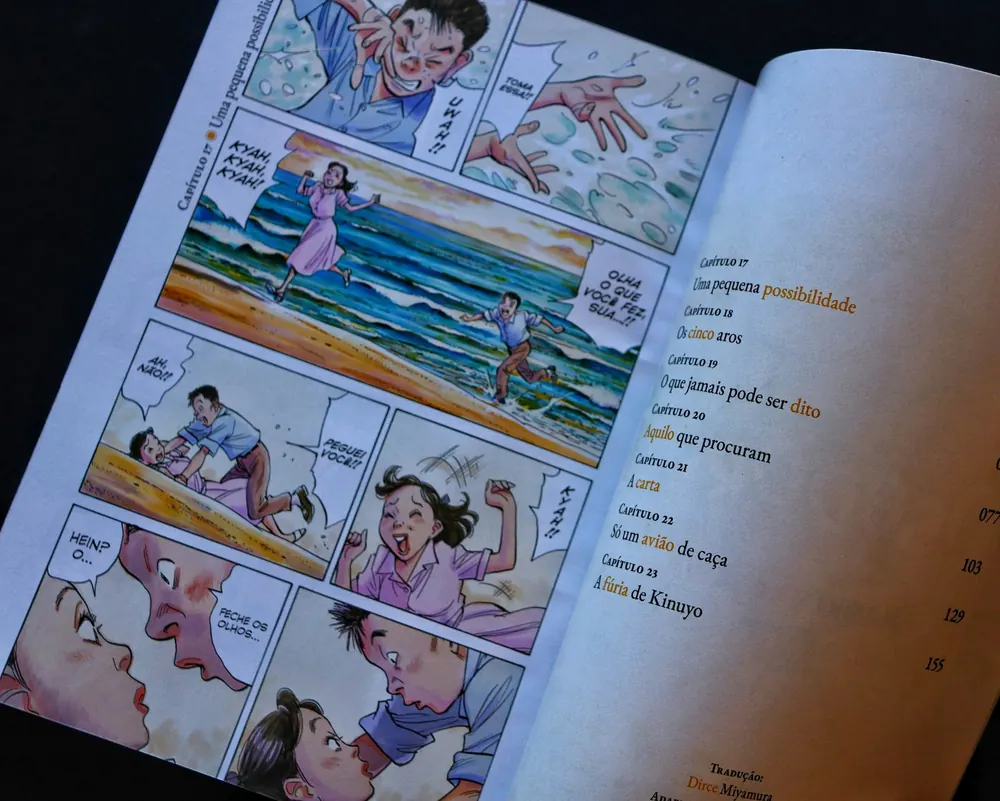
Transfer to textGraphic narratives combine language, sequence, visual evidence, framing and the spaces between panels. Research in multimodal literacy and comics education provides a rationale for explicit instruction using these forms—but it does not prove that any comic automatically improves reading.
Selected starting points for educators:
The COMLITERICKS model itself remains a proposed instructional approach for empirical piloting.
 Many ways to read.